
×
ItalianoEnglish
Set as default language

Grandangolo Communications

  • Home
  • Company
  • Services
    • Public Relation
    • Digital PR
    • Marketing
    • Lead Generation
    • Events
  • Best Practice
  • Customer Press Room
  • Contacts
  • Languages
  • Home
  • Customer Press Room
  • Eset
  • ESET discovers NGate: Android malware that uses the NFC module to clone victims' credit and debit cards

Customer Press Room

ESET discovers NGate: Android malware that uses the NFC module to clone victims' credit and debit cards

by Grandangolo Communications / Friday, 06 September 2024 / Published in Eset

NGate cloned the NFC data of victims' payment cards and redirected them to withdraw money from ATMs. This is the first time that Android malware with this capability has been used without the victims having rooted their devices

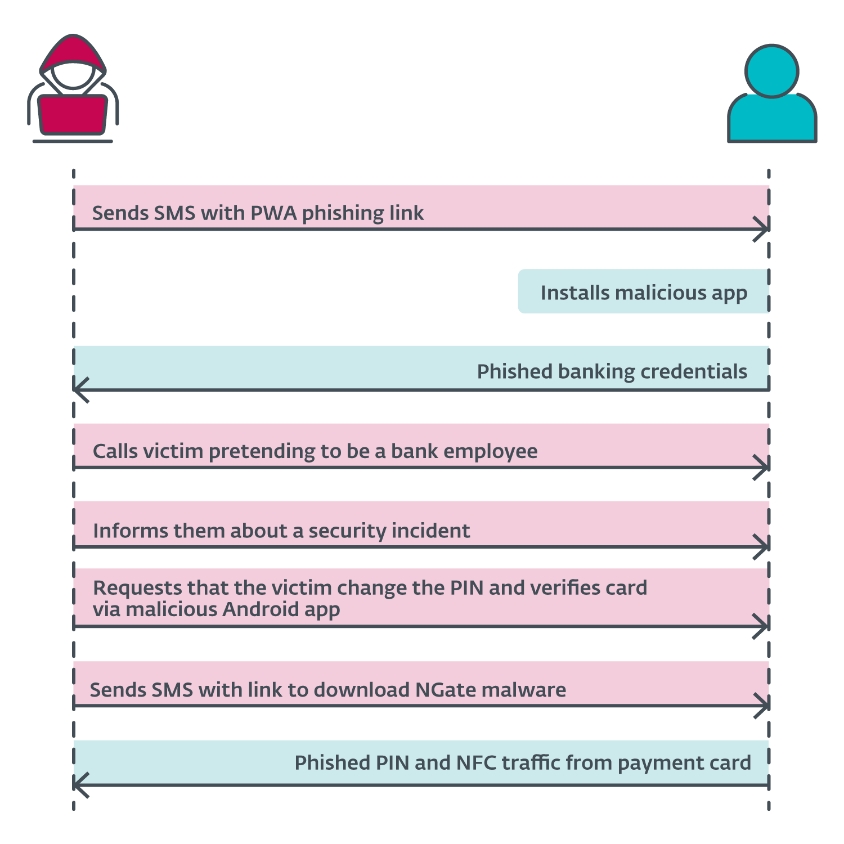
Researchers of ESET, a global European leader in the cybersecurity market, have uncovered a cybercrime campaign targeting customers of three banks in the Czech Republic. The malware used, which ESET has named NGate, has the unique ability to redirect data from victims' credit cards via a malicious app installed on their Android devices, sending it to the attacker's Android phone. The main objective of this campaign was to facilitate unauthorized withdrawals from victims' bank accounts. This was possible by redirecting the data from near field communication (NFC) of victims' physical payment cards, via compromised Android smartphones, to the attacker's device, using the Android NGate malware. The latter then used this data to carry out ATM transactions. If the operation failed, the attacker had a backup plan to transfer funds from victims' accounts to other bank accounts.

"We have never seen this NFC redirection technique in any previously discovered Android malware. The technique is based on a tool called NFCGate, designed by students at Darmstadt University of Technology, Germany, to capture, analyze or alter NFC traffic; that's why we called this new malware family NGate," says Lukáš Štefanko, Senior Malware Researcher at ESET who discovered the new threat.

Victims downloaded and installed the malware after being tricked into thinking they were communicating with their bank, believing their device was compromised. In reality, the victims had unknowingly compromised their Android devices by downloading and installing an app from a link in a deceptive SMS message regarding a potential tax refund.

It is important to note that NGate has never been available in the official Google Play Store.

The Android NGate malware is linked to the phishing activities of a malicious actor who has been operating in the Czech Republic since November 2023. However, ESET believes that these activities were suspended after the arrest of a suspect in March 2024. ESET Research detected the first movements of the malicious actor against customers of major Czech banks in late November 2023. The malware was distributed via short-lived domains that simulated legitimate banking websites or applications official mobile banking available in the Google Play Store. These fraudulent domains were identified through the ESET Brand Intelligence Service, which monitors threats affecting a customer's brand. During the same month, ESET reported the findings to its customers.

Attackers exploited the potential of Progressive Web Apps (PWAs), as ESET reported in a previous publication, only to then refine their strategies using a more sophisticated version of PWAs known as WebAPKs. Ultimately, the operation culminated in the deployment of the NGate malware.

In March 2024, ESET Research discovered that Android NGate malware was available on the same distribution domains previously used to facilitate phishing campaigns that distributed malicious PWAs and WebAPKs. After being installed and opened, NGate displays a fake website that requests the user's banking information, which is then sent to the attacker's server.

In addition to NFC data redirection, an attacker with physical access to payment cards could copy and emulate them, for example by reading them through purses or wallets in crowded places. However, this method is limited to small contactless payments. "Protecting yourself from complex attacks like these requires the use of proactive measures against phishing, social engineering and Android malware. This means checking website URLs, downloading apps only from official stores, keeping PIN codes secret, using security apps on phones, turning off the NFC function when it is not needed, using protective cases or virtual cards protected by authentication", advises Štefanko.

For more technical information on the new NFC threat, see the blog “NGate Android malware relays NFC traffic to steal cash” on WeLiveSecurity.com. Follow ESET Research on Twitter (now known as X) For the latest news from ESET Research.

Tagged under: Eset, NGate

About Grandangolo Communications

What you can read next

ESET: Evasive Panda group from China spreads malware via updates of legitimate applications
ESET researchers have detected new malware in the official Android App Store
ESET has discovered the WinorDLL64 backdoor, a probable component of the Lazarus system

Customer Press Room

  • Acronis Introduces MDR by Acronis TRU to Offer MSPs 24/7 Threat Detection and Response

    The service allows MSPs to offer customers...
  • SentinelOne expands strategic partnership with Google Cloud to deliver AI-powered autonomous security on a global scale

    The partnership will lead to the development of new...
  • Vertiv Announces Expansion of Manufacturing Capacity in Infrastructure Solutions, Energy and Rack Systems to Meet Growing Demand

    New and expanded production facilities in America...
  • Eon and SentinelOne partner to improve cloud data security and AI resilience

    The combination of features will broaden the ...
  • Vertiv expands thermal portfolio with new wall cooling system for edge and small data rooms in EMEA

    Designed to operate 24/7 in busy environments...

Archives

  • April 2026
  • March 2026
  • February 2026
  • January 2026
  • December 2025
  • November 2025
  • October 2025
  • September 2025
  • August 2025
  • July 2025
  • June 2025
  • May 2025
  • April 2025
  • March 2025
  • February 2025
  • January 2025
  • December 2024
  • November 2024
  • October 2024
  • September 2024
  • August 2024
  • July 2024
  • June 2024
  • May 2024
  • April 2024
  • March 2024
  • February 2024
  • January 2024
  • December 2023
  • November 2023
  • October 2023
  • September 2023
  • August 2023
  • July 2023
  • June 2023
  • May 2023
  • April 2023
  • March 2023
  • February 2023
  • January 2023
  • December 2022
  • November 2022
  • October 2022
  • September 2022
  • August 2022
  • July 2022
  • June 2022
  • May 2022
  • April 2022
  • March 2022
  • February 2022
  • January 2022
  • December 2021
  • November 2021
  • October 2021
  • September 2021
  • August 2021
  • July 2021
  • June 2021
  • May 2021
  • April 2021
  • March 2021
  • February 2021
  • January 2021
  • December 2020
  • November 2020
  • October 2020
  • September 2020
  • August 2020
  • July 2020
  • June 2020
  • May 2020
  • April 2020
  • March 2020
  • February 2020
  • January 2020
  • December 2019
  • November 2019
  • October 2019
  • September 2019
  • August 2019
  • July 2019
  • June 2019
  • May 2019
  • April 2019
  • March 2019
  • February 2019
  • January 2019
  • December 2018

Categories

  • A10
  • Abstract
  • abstract
  • Acronis
  • Ally Consulting
  • Arrow
  • Arrow Electronics
  • Axiante
  • Babel
  • Computer Center
  • Cohesity
  • Italy Cloud Consortium
  • Consys
  • D-Link
  • Eset
  • G.B. Service
  • Habble
  • HiSolution
  • HYCU
  • Icos
  • Information Tecnology
  • Innovaway
  • Ivanti
  • Link11
  • MobileIron
  • Netalia
  • Nethive
  • Nexthink
  • Nuvis
  • Praim
  • QAD
  • Qualys
  • Red Hot Cyber
  • Riverbed
  • Saviynt
  • Sensormatic
  • SentinelOne
  • Talent Software
  • Vectra
  • Vectra AI
  • Vertiv

Office printing, digital PR, marketing, lead generation: all projects are born from our passion and expertise, with an inevitable touch of creativity and innovation.

COMPANY

Grandangolo Communications Srl
Via Sardegna 19
20146 Milano
Telephone +39 335 8283393
info@grandangolo.it

I SERVIZI

  • Home
  • Company
  • Services
  • Best Practice
  • Customer Press Room
  • Contacts
  • Languages

CONTACTS

  • Contacts
  • Cookie policy
  • Privacy policy

© 2019 GRANDANGOLO COMMUNICATIONS SRL | P.IVA IT 06394850967 | All rights reserveD.

Powered by Webpowerplus

TOP