Accelerated digitization and enhancement of edge infrastructures are among the key trends to monitor in the entire digital ecosystem
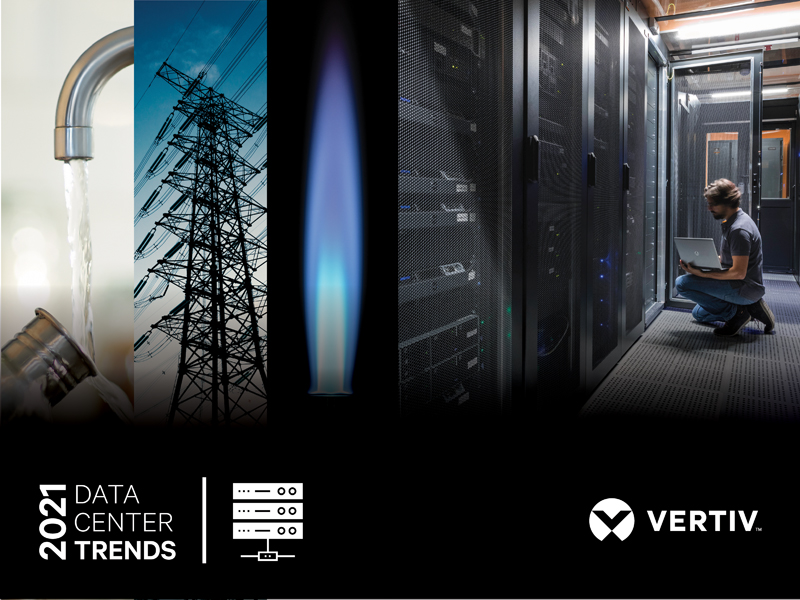
Vertiv (NYSE: VRT), a global provider of critical digital infrastructure solutions, expects the challenges of data centers and the continued reliance on them that have emerged during the COVID-19 pandemic to grow further in 2021, manifesting themselves in new ways. Vertiv experts confirm the critical issues regarding water, electricity and gas also for next year, adding a fourth critical issue of data centers in terms of use of the information ecosystem that surrounds them, with all the expectations and responsibilities that follow.
Data centers have long been characterized by high levels of availability and accessibility, but the move to a utility level will be visible in two ways. First, high expectations for network availability will extend into rural and remote areas, bringing critical applications to more users. This will inevitably increase the pressure on data centers, which will be asked to maintain connectivity also to the edge infrastructures of their networks. Second, any distinction between availability and connectivity will be erased, as the ability to secure and secure connections across increasingly distributed hybrid networks becomes as important a requirement as any other traditional data center uptime measure.
“Data centers have been moving toward a utility model for some time, but the pandemic has crystallized the need to establish the types of security features that were common in other utilities,” said Gary Niederpruem, Chief Strategy and Development Officer at Vertiv. "It is not just about working from home, although this is something to take into consideration. Even more important is supporting the digital economy in its most critical forms which include a dependence on telemedicine and health, the enhancement of e-commerce, global telecommunications and mass media."
The pandemic has effectively drawn a new baseline for digital infrastructure. In this context, Vertiv experts have identified the following trends to monitor in 2021, such as:
- Digitalization on the Fast Forward: COVID-19 will have a lasting effect on the workforce and IT ecosystem supporting the new work-from-home model. Vertiv experts predict that pandemic-driven investment in IT infrastructure will continue and increase, enabling more secure, reliable and efficient remote working capabilities. Remote visibility and management will become critical to the success of these work-from-home models. Several remote services have already emerged to minimize the need for on-site support, and these modalities will continue well beyond the end of the pandemic. Any actions taken cautiously at the start of the crisis will be accelerated as we enter the new year, leading organizations to accept these changes not as a temporary situation, but rather as a permanent adjustment to the way we work and develop our business. Customers are looking to minimize their on-site presence and this, over time, will change what will be done in person versus what will be done remotely. It follows that connectivity, remote monitoring, data analytics and even artificial intelligence will play an important role in our ability to make decisions.
“Recovery requires a shift in mindset for most organizations,” said John-David Lovelock, Dinguished Research Vice President at Gartner, in a recent statement. "There is no going back. We need a relaunch focused on progress."
- Bringing the capabilities of large data centers to small, peripheral spaces: Today's Edge is more critical and complex, from a functional point of view it is an extension of the data center that replaces the IT environment of the past. Cost and complexity have prevented the implementation of data center best practices in these spaces, but that is changing. Vertiv experts expect continued focus on bringing hyperscale and enterprise-grade capabilities to these specific sites. This includes greater intelligence and control, an increasing emphasis on availability and thermal management, and a greater focus on the energy efficiency of systems.
"Wherever there is high data processing density, there will be a demand for edge computing. This growing demand will require a more resilient and intelligent edge infrastructure," said Giordano Albertazzi, president of Vertiv in Europe, Middle East and Africa (EMEA). "We are seeing an expansion of the edge in many countries and, eventually, it will extend to emerging markets as well. Edge deployments are also closely linked to other key trends such as 5G and environmental sustainability, and the integration of edge sites with energy networks can support the transition to renewable energy."
- The topic on 5G concerns energy consumption and efficiency: in this first phase of 5G planning and market availability, the discussion has rightly focused on the ultimate benefits of the technology (greater bandwidth and reduced latency) and the applications to which it will give rise. However, in 2021, as many countries begin their 5G deployments and early adopters begin to promote scalable solutions, the focus will be on the significant increases in energy consumption caused by 5G and the implementation of more efficient and effective strategies. The network densification necessary to fully fulfill the promise of 5G inevitably adds to the increase in energy demand, estimated to be 3.5 times higher than that of 4G. Next year will therefore see a greater focus on managing this significant increase in energy consumption by exploring more efficient products and models.
 Sustainability is in the foreground: 5G is part of the broader context of sustainability. As the proliferation of data centers continues and even accelerates, especially in the hyperscale space, cloud and colocation providers will face greater scrutiny of their energy and water consumption. The amplification of the debate on climate change and the evolution of the political situation in the United States and globally will only further increase attention on the data center sector, which represents approximately 1% of global energy consumption. The coming year will see a wave of innovation focused on energy efficiency across the data center ecosystem. The benefits for data center operators are clear, starting with reduced costs, compliance with existing and anticipated regulations, and the goodwill that comes from gaining a leadership position in the global sustainability movement. The goal is to look for important innovations throughout the data center infrastructure space and especially in the area of thermal management.
For more information on industry trends for 2021 and the full range of Vertiv solutions for data centers and communications networks, visit Vertiv.com.