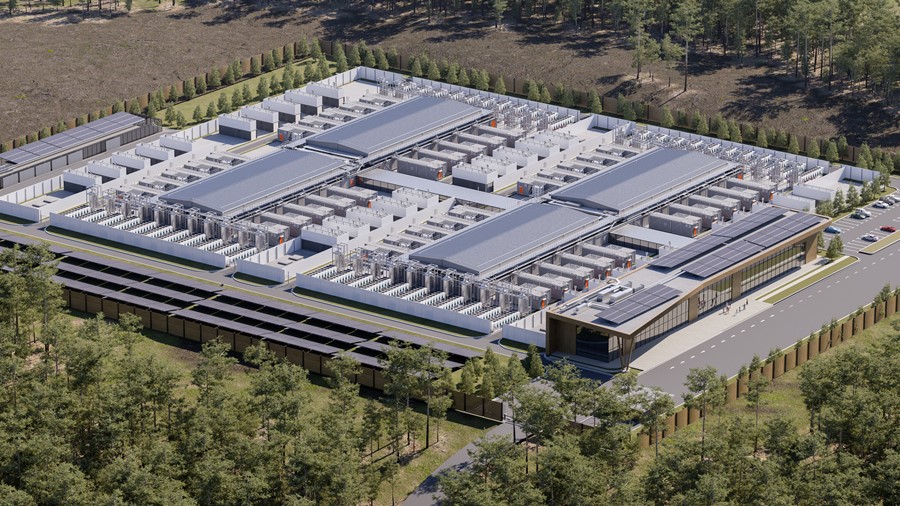
Global launch of an end-to-end solution that delivers flexible, fast-to-deploy infrastructure to simplify and accelerate the build of high-performance data centers
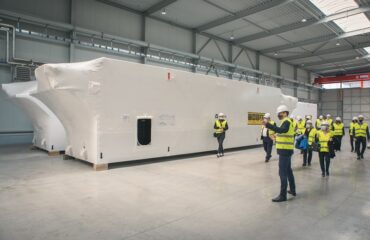
Vertiv (NYSE: VRT ), a global leader in critical digital infrastructure, announced the global availability of Vertiv™ OneCore, a scalable prefabricated solution that integrates Vertiv's proven power, cooling and IT infrastructure technologies into a single factory-assembled system. Designed to accelerate the deployment of high-density data centers, the Vertiv OneCore solution simplifies project execution by reducing on-site complexity and reducing lead times. The solution is available globally for a wide range of deployments, including enterprise, colocation, sovereign and neocloud environments.
Vertiv OneCore offers a unified and comprehensive “slab-up” approach that streamlines the entire process, from design to installation and commissioning, through a single point of contact. The flexible design is based on proven prefabricated building blocks, including IT space setups such as Vertiv™ SmartRun, housed inside a steel structure supplied by Vertiv. This design simplifies logistics, reduces on-site labor and complexity, and ensures consistent quality, cost and delivery times. Additionally, Vertiv™ Unify provides integrated system visibility and centralized management.
“Vertiv OneCore is our answer to reducing complexity and enabling speed in building large-scale data center capacity,” said Viktor Petik, senior vice president of infrastructure solutions at Vertiv. "The challenge is not just to design for today's needs, but to prepare an adaptable foundation for the future. This solution reduces the complexity of projects by standardizing key components, while maintaining the flexibility to scale, evolve, easily expand and integrate new technologies based on business and IT needs."
Vertiv OneCore is ideal for data centers with mixed loads or extreme rack densities. Its modular electrical and mechanical designs support parallel manufacturing, saving time and costs. The approach is highly flexible and free from hard dimensional limitations, allowing for custom configurations that maximize available IT space and improve airflow for environmental control.
Main features:
- Scalable power capacity: supports 5 to 50 MW in a single block, to meet the growing power demand of AI applications and high-density deployments.
- Rack density flexibility: configurable from 96 to 944 racks, supporting low to extreme densities and enabling custom designs based on IT requirements.
- Integrated power and cooling systems: provides space- and energy-efficient cooling and power infrastructure using Vertiv's proven technologies, including liquid cooling and advanced heat dissipation systems, as well as scalable power management systems and UPS.
- Concurrent maintainability: the electrical and thermal systems are designed to ensure availability and resilience even during maintenance or upgrades.
- Optimized environmental performance: It operates at temperatures between -20°C and 55°C, ensuring reliable performance in varying global climates.
- Advanced redundancy: includes redundant configuration options for both primary and secondary fluid networks, as well as distributed electrical redundancy.
- Wide voltage compatibility: compatible with medium voltages from 11 to 35 kV and three-phase AC power from 400V to 480V, in line with regional standards.
- Comprehensive after-sales services and support: The solution is supported by Vertiv's global service network. This way, customers have access to expert-guided commissioning, proactive maintenance programs and rapid response capabilities to ensure long-term performance, availability and operational efficiency.
Vertiv™ OneCore perfectly complements Vertiv's broad portfolio of power, cooling and management solutions, including UPS Vertiv™ Trinergy™, switchgear, busway, Vertiv™ CoolChip CDU and perimeter cooling, Vertiv™ CoolLoop Trim Cooler and the management system Vertiv™ Unify.
The Vertiv™ OneCore solution can also support customers' sustainability strategies through increased efficiency, reduced energy requirements and a flexible design that can adapt to evolving technology standards.