

The security of mobile devices, apps and users will have to be the main priority for every CIO as employees will work everywhere in the new 'Enterprise Everywhere'
MobileIron (NASDAQ:MOBL), the mobile-centric security platform for the Everywhere Enterprise, today announced the results of a new survey, which revealed that more than 80% of people would not return to working in the office full-time, despite one in three employees (30%) saying that being separated from their team was the biggest obstacle to productivity during lockdown.
The Covid-19 pandemic has clearly changed the way people work and accelerated the trend towards remote working. This has also created new security threats for IT departments, as employees increasingly use their personal devices to access corporate data and services. To the critical issues posed by the new “Everywhere Enterprise” – where employees, IT infrastructures and customers are everywhere – adds the fact that employees do not consider security a priority. In fact, the survey found that a third of workers (33%) consider cybersecurity an issue of lower priority.
The current remote working environment has also triggered a new threat landscape, with bad actors increasingly targeting mobile devices with phishing attacks. These attacks, from the simplest to the most sophisticated, have a good chance of success, even considering that many employees are unaware of how to identify and avoid a phishing attack. The study revealed that 43% of employees worldwide are unable to recognize a phishing attack.
“Mobile devices have access to everything, but most employees have inadequate security measures that allow hackers to continue to succeed,” he said Riccardo Canetta, Regional Sales Director, Mediterranean Area di MobileIron. "Hackers know that people are freely using their insecure mobile devices more than ever to access company data, and they are increasingly targeting them with phishing attacks. Every company should implement a mobile-centric security strategy that prioritizes user experience and allows employees to be productive on any device, anywhere, without compromising personal privacy."
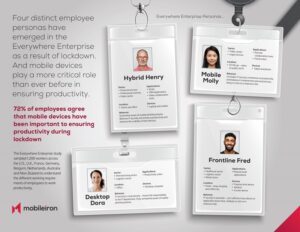
From the 'Everywhere Enterprise' survey, four different types of employees were identified who, following the lockdown, use their mobile devices differently depending on their respective tasks, revealing various critical issues:
Henry's hybrid environment:
- Typically works in financial services, professional services or the public sector.
- Ideally divide your time equally between working at home and going to the office for face-to-face meetings; Although this employee enjoys working from home, being isolated from his team has proven to be the biggest obstacle to productivity.
- Use a laptop and mobile device, along with secure access to email, CRM applications, and video collaboration tools, to stay productive.
- He believes that IT security ensures productivity and improves the usability of devices. At the same time, this employee is only partially aware of phishing attacks.
Molly's mobile environment:
- He constantly works on the move using a range of mobile devices, such as tablets and phones, and often relies on public WiFi networks.
- It relies on remote collaboration tools and cloud suites to get the job done.
- He sees unreliable technology as the biggest obstacle to productivity as he is always on the go and relies heavily on mobile devices.
- See IT security as a hindrance to productivity because it slows down your ability to complete tasks; this employee also believes that IT security compromises personal privacy.
- We are talking about a type of worker who, due to a strong dependence on mobile devices, is more likely to click on a malicious link.
Dora's desktop environment:
- He finds the distance from the team and working from home an obstacle to productivity and can't wait to return to the office.
- Prefers to work on a desktop computer from a fixed position rather than on mobile devices.
- Relies heavily on productivity suites to communicate with colleagues in and out of the office.
- Make IT security a low priority and let the IT department take care of it.
- This employee is also only partially aware of phishing attacks.
Fred's frontline environment:
- Work in the field in sectors such as healthcare, logistics or retail.
- Work from fixed and specific locations, such as hospitals or retail stores; this employee cannot work remotely.
- It relies on specially developed devices and applications, such as medical or logistics equipment and applications; this employee is not as dependent on personal mobile devices for productivity as other roles.
- He is aware of the importance of IT security and cannot afford downtime of devices or applications, given the specialized nature of his work.
“With so many employees leveraging mobile devices to stay productive and work from anywhere more than ever before, organizations must adopt a Zero Trust security approach to ensure only trusted devices, apps and users can access corporate resources,” Canetta continued. "Organizations must also strengthen defenses against mobile threats, as cybercriminals increasingly exploit text and SMS messages, social media and link-sharing messaging apps with malicious attacks. To prevent unauthorized access to corporate data, businesses must ensure ongoing anti-phishing controls that go beyond email to protect users wherever they work, on every device they use to access resources."
The research conducted interviews with 1,200 workers in the United States, the United Kingdom, France, Germany, the Netherlands, Australia and New Zealand. TO this link you can download a copy of the research.