The new models are designed to reduce costs and simplify implementation
Vertiv, (NYSE: VRT), a global provider of critical digital infrastructure and continuity solutions, has released in-depth research that identifies models that can help organizations take a more standardized approach to edge computing deployments to optimize time and cost.
It carry over Edge 2.0 Archetypes: Ready-to-deploy Edge infrastructure templates, is wet on archetypes and taxonomy related to the edge introduced by Vertiv in 2018. The new research even better classifies edge sites based on factors such as: location and external environment, number of racks, power requirements and availability, site location, passive infrastructure, provider and number of sites to be deployed.
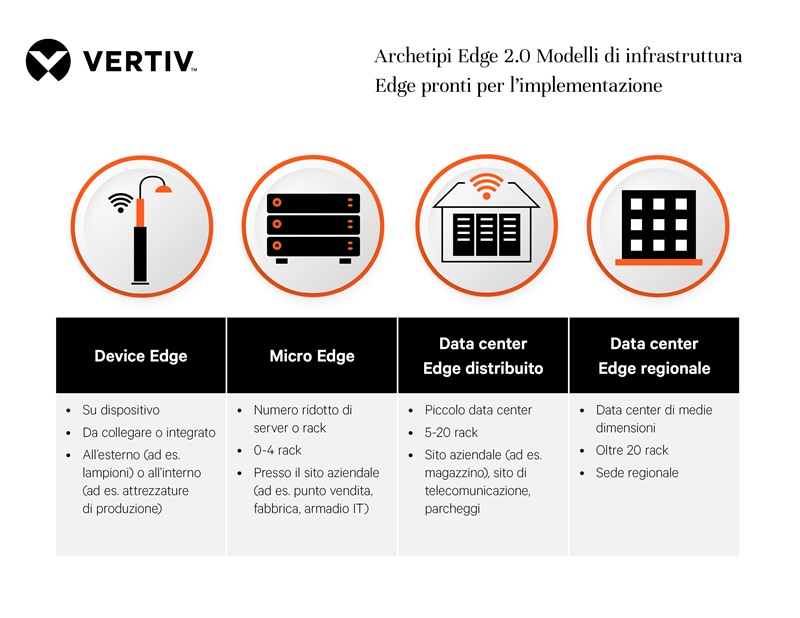
- Device Edge: in this case the data processing takes place on the devices themselves, whether they are stand-alone devices or integrated into larger architectures, as in the case of intelligent traffic lights or video surveillance systems.
- Micro Edge: This is a small stand-alone solution, which can range from one or two servers up to four racks. It could be deployed within an organization to create small distributed data centers or at a telecommunications site to connect processes and applications that reside in network closets.
- Distributed Edge Data Center: They can be located within an on-premise data center (which can be a pre-existing corporate data center, a network room or a new independent facility), or reside at a co-locator. Distributed Edge data centers are already widespread in manufacturing sites, healthcare facilities, smart cities and telecommunications networks.
- Regional Edge Data Center: they are structures distant from the main data center, built specifically to host a data processing infrastructure. It shares many features typical of hyperscale data centers, for example in terms of air conditioning and security, so it guarantees high levels of reliability. This model is widely used in the retail world and serves as an intermediate site for data processing.
The introduction, three years ago, of the archetypes related to edge computing contributed to the understanding of this paradigm. This was the first structured attempt which, based on the numerous information collected on the subject, allowed companies to begin to orient themselves within the Edge world. Since then, other public and private organizations have worked on the same issues – often with proactive support from Vertiv – to develop standard processes and technologies to accelerate the understanding and diffusion of this paradigm. The infrastructure models described above represent the next logical step.
“As the edge matures and sites proliferate and become more sophisticated, there is a growing need for infrastructure models that can standardize designs and equipment to increase efficiency while reducing costs and implementation times,” he said. Martin Olsen, global vice president, edge strategy and transformation di Vertiv. "Edge sites will continue to require some customization to meet the specific needs of users, but the models we have developed simplify many fundamental choices and introduce engineering that is now necessary in this area too. The research is particularly useful for those who want to specialize in this sector, such as channel partners and IT managers."
The research, carried out in collaboration with the analysis company STL Partners, points out that specific interventions may be required based on factors such as the environmental context, the reference market, the equipment in operation, the management, safety and maintenance policies and the connectivity used. However, these specificities can be applied within the identified models and do not compromise the benefits of greater standardization.
“The adoption of the four models that we have identified provides undeniable advantages, starting with a speed up in the implementation of sites which brings with it an acceleration of the go-to-market of products and services”, stated Dalia Adib, director, consulting and edge computing practice lead of STL Partners. “The Edge market is growing strongly and can be further accelerated by introducing some level of standardization in the language used to describe it.”
The report also examines the Edge infrastructure requirements of some vertical markets such as the manufacturing industry, retail and telecommunications and illustrates the currently most widespread models, providing useful advice for operators in the sector.
Vertiv has also developed a tool available online to help customers, business partners and all those interested in determining the model best suited to their needs. Reports and tools are accessible at Vertiv.com/EdgeArchetypes-EMEA.