The management of energy consumption and carbon emissions promotes regulation, standardization and the search for alternatives to traditional generators
In 2023, data centers will be affected by greater regulation and more intense supervision by external bodies, given the increase in energy and water consumption in the sector and ongoing climate change. Vertiv (NYSE: VRT), a global provider of critical digital infrastructure and continuity solutions, has identified what will be one of the five trends for the sector in 2023: the maximum attention to the environmental and territorial impact of data centers globally.
"The sector is growing rapidly, due to the ever-increasing number of applications requiring computing and storage capacity, leading to a corresponding increase in energy and water use in data center infrastructures. Pursuing energy and water efficiency is fundamental to progress and future sustainability", said Giordano Albertazzi, Chief Operating Officer of Vertiv. "Adopting stricter legislation is inevitable and will lead to important innovations. The process will not always be simple or linear, but it can be managed with the support of expert partners in the sector and with the use of innovative solutions capable of anticipating changes and satisfying the requirements of a constantly evolving sector."
Changes in chip design and manufacturing, which limited the energy consumption of servers in the first decade and a half of the 2000s, have shown their limits, as a result there has been a surge in the amount of energy used by servers. In a recent report, titled Silicon heatwawe: the looming change in data center climates and published by the Uptime Institute, data from the American company SPEC (Standard Performance Evaluation Corporation) was cited which indicates an increase in server energy consumption of 266% since 2017. This acceleration is focusing attention on environmental awareness and sustainability throughout the market. Below, the main trends identified for 2023 by Vertiv experts:
More stringent regulations for data centers
Growing pressures to meet water and energy demands are forcing governments to increase their focus on data centers and their resource consumption. It is estimated that data centers are today responsible for approximately 3% of energy consumption globally and is expected to reach 4% by 2030. The average energy use of a hyperscale data center (HDC) is around 20-50MW per year (the amount of energy needed to power up to 37,000 homes). Vertiv experts predict that in 2023 this phenomenon will provoke greater government control.
In some areas of the world it is already a reality. Dublin (Ireland) and Singapore have already adopted measures to control energy consumption in data centers - especially in drought-prone areas - and this could trigger the same mechanism in other countries. The US Department of Energy has stated that the average effective water use (more) of a data center that uses evaporative cooling systems, is equal to 1.8 liters per KWh. This type of data center can consume data 3 to 5 million liters of water per day, comparable to the average consumption of a city of 30/50,000 inhabitants. The sector will continue to implement measures for self-monitoring and self-regulation, in particular by prioritizing environmentally friendly thermal projects, but 2023 will at the same time see an increase in regulatory controls.
Hyperscalers and operators who rely on modular solutions
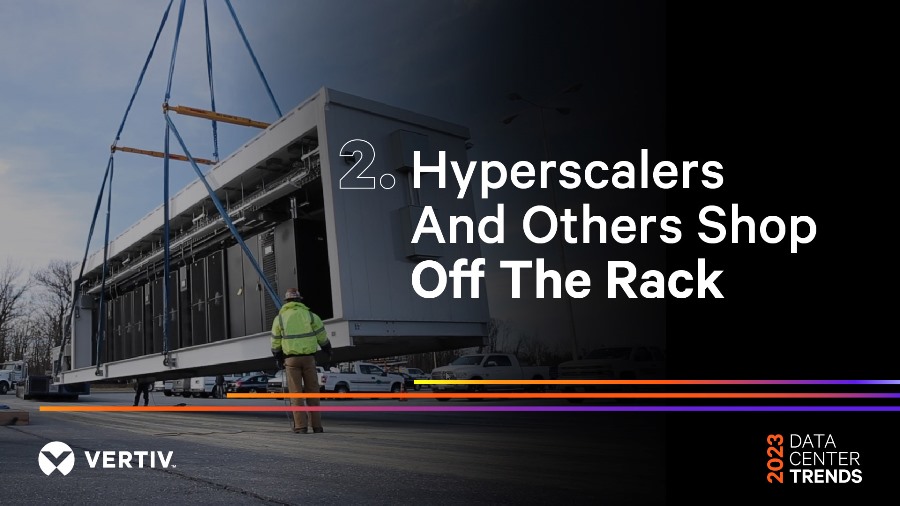
In a recent survey sponsored by Omdia, 99% of enterprise data center operators say prefabricated and modular data centers will be part of their future strategy. Vertiv's analysis for 2023 indicates a strong inclination in the same direction also for hyperscale architectures, to take advantage of the speed and efficiency that this standardization offers.
This gives rise to a new concept for the main cloud providers who specifically cater to colocation service providers, which have been operating in a standardized mode for years. In particular, these cloud providers are entrusting their new infrastructures to colos, to leverage their market experience and proven replicability and speed of implementation. Before long, standardization – moving from modular components such as power and air conditioning units and skids, to entirely prefabricated structures – will become the default approach not only for enterprises, but also for hyperscale structures and the network edge.
Concrete alternatives to diesel generators
The diesel generator has long been an imperfect but indispensable component of the data center ecosystem. It is capable of producing energy but often remains unused and at the same time requires maintenance or fuel replacement after periods of inactivity. Furthermore, during use it produces CO emissions2 which operators are desperately trying to avoid. To date, some organizations already rely on batteries for longer energy support – up to five minutes in some cases – and design their data centers with a minimum supply of generators.
2023Trends-Graphics-EN
This is a transition phase that aims to reduce the role of generators, while the sector searches for viable alternatives – including new battery technologies – for sustained backup power. Vertiv experts indicate that 2023 will be the year in which alternative systems emerge, with a preference towards hydrogen fuel cells. The latter will initially operate as a generator, i.e. providing temporary support for consumption, with the expectation of becoming a system capable of prolonged or even continuous operation.
Higher densities change thermal strategies
After years of relatively static rack density, data center operators are reporting a rapid increase in rack density over the past three years. The survey confirms this Global Data Center Survey 2022 conducted by the Uptime Institute. This phenomenon is especially significant among large enterprise and hyperscale data centers. In fact, nearly half of those operating facilities of 10MW and above reported having racks larger than 20kW, while 20% reported racks larger than 40kW.
The data is consistent with the progressive evolution of server technologies with liquid cooling systems and with the greater diffusion and adoption of this type of device. Increases in server power consumption occur amid the need to quickly add capacity. This forces operators to increase the density of racks in pre-existing spaces in their facilities, consequently increasing the thermal profile with the consequent need to implement liquid cooling systems. The new OCP and Open19 direct chip cooling standards will only accelerate the trend towards using these environmentally friendly cooling systems in the coming year.
5G networks and the metaverse, a winning synergy
Omdia, in the document 2022 Mobile Subscription and Revenue Forecast, predicts that nearly half of all mobile subscriptions – more than 5.8 billion – will move to 5G networks by 2027, pushing computing ever closer to the user. The metaverse, on the other hand, is an application in search of a very high density and low latency computer network. In 2023 we will see these two realities interact, with metaverse implementations that will leverage 5G networks to enable the ultra-low latency features required by applications. Ultimately, all of this will require a rapid increase in computing power at 5G edge locations and we will be able to start verifying this starting from 2023, followed by larger deployments in the following years. With the growing sophistication of the network edge, the demand for more high-performance supporting infrastructure will also arise. This will include technologies such as artificial intelligence, virtual reality planning and management systems and greater adoption of lithium-ion battery UPS systems for the edge of the network, a growing trend that has seen sales increase by 2 to 8% between August 2021 and August 2022 (IDC source).
“Sustainability has been the biggest area of focus for the data center industry in recent years, and this aligns with the emphasis that will be in 2023 in terms of increased government regulation, along with growing interest in renewable energy sources,” said Karsten Winther, EMEA President at Vertiv. "The further we go, the more operators and data center managers will need to rely on partners who have adequate infrastructures and who are able to direct them towards the best technologies to help them achieve the zero impact goal. With these innovations and transformations, in particular with 5G and the metaverse, 2023 promises to be a very stimulating year for our customers and for the entire sector."
More information about expected trends for 2023 and Vertiv solutions for data centers and communications networks is available at Vertiv.com.