A consortium of seven organizations has been chosen by Clean Hydrogen Partnership to develop a next-generation fuel cell platform to ensure a greener future for data centers around the world
Vertiv, (NYSE: VRT), a global provider of critical digital infrastructure and continuity solutions, announces that Clean Hydrogen Partnership will provide €2.5 million to help finance a project to develop low-carbon fuel cells to power data centers. The hope is that in this way we can reduce emissions from individual operating activities by up to 100%. The EcoEdge Prime Power (E2P2) project is a new proof-of-concept initiative that aims to develop and prove particularly economical and resilient primary power solutions for data center management.

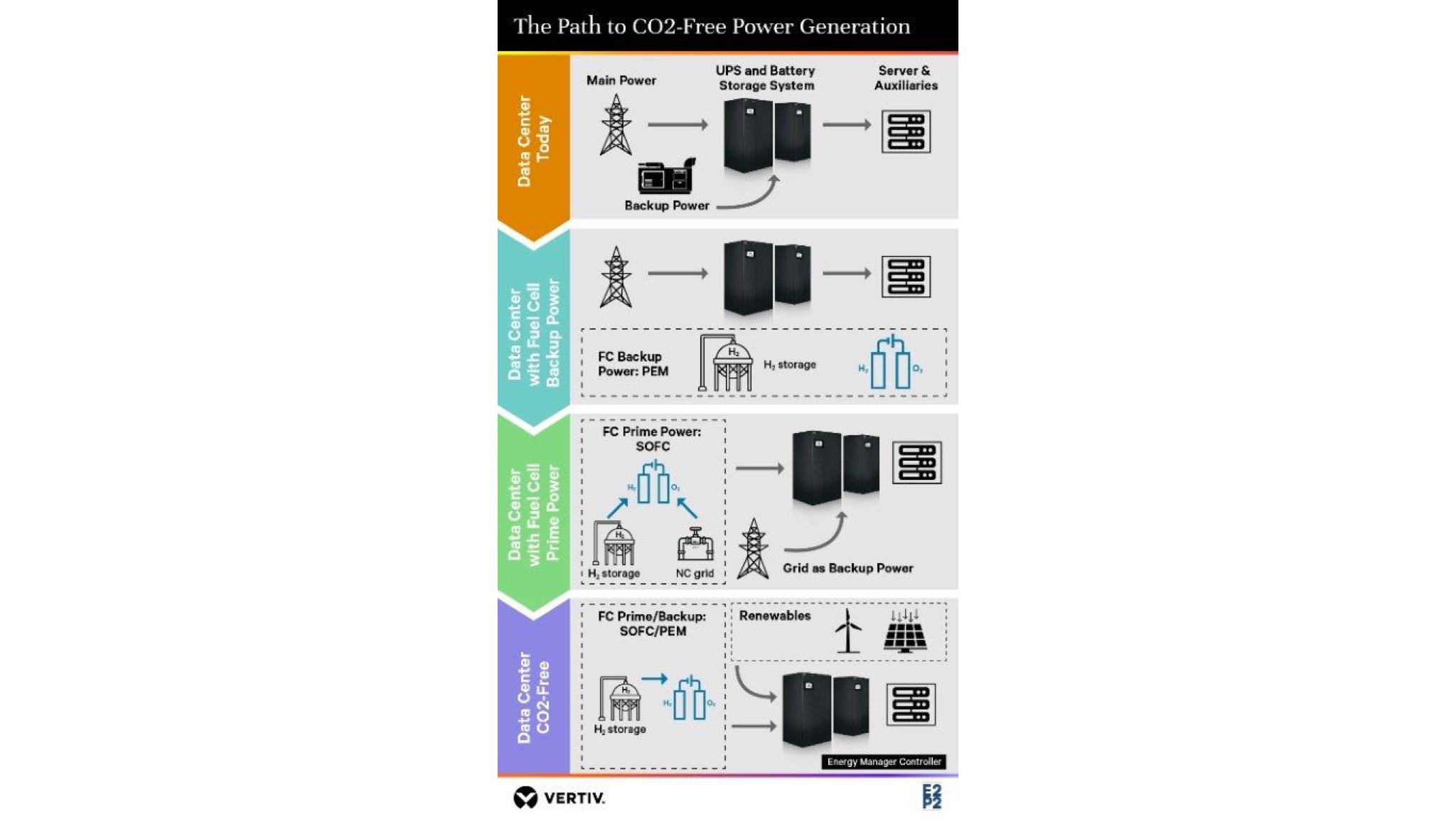
A consortium of seven companies – Equinix, InfraPrime, RI.SE, Snam, SolidPower, TEC4FUELS and Vertiv – will study the integration of solid oxide fuel cells with UPS (Uninterruptible Power Supply) technology and lithium ion batteries in order to provide resilient and clean primary energy for the construction of data centers and other critical infrastructures. The use of solid oxide fuel cells (SOFC) for primary power will enable the use of green hydrogen for fuel cell-based applications, both for primary and backup power systems.
“Digitalisation and the data center industry are growing at ever faster rates and it is therefore even more important to accelerate its path towards an eco-sustainable future,” said Giordano Albertazzi, president of Vertiv Europe, Middle East and Africa. "This can only happen by developing clean and innovative technologies such as Fuel Cell solutions, which will provide sustainable energy to the digital world. Vertiv is proud to actively contribute to the E2P2 proof-of-concept initiative and is excited to be able to make next-generation power solutions available to its customers on a global scale."
The E2P2 project is the latest in a series of initiatives that Vertiv has conducted on the subject of sustainability and, more generally, ESG (Environmental, Social and Governance). In fact, Vertiv is also part of the Sustainable Digital Infrastructure Alliance (SDIA) and the European Data Center Association (EUDCA) and contributes to the Climate Neutral Data Center Pact which aims to meet the goal set by the European Commission for zero-impact data centers by 2030. The E2P2 project is part of the company's commitment to prioritize and support the development of clean, sustainable and renewable energy solutions for data centers.
A greener future for the sector
Fuel cells are recognized as a cleaner, quieter energy solution that can reduce the demand on urban electricity grids. They can be deployed on-site on a data center campus and operate using natural gas, biogas, LPG or green hydrogen – transportable and deliverable on existing gas networks.
The E2P2 project represents an important step towards significantly reducing carbon emissions while continuing to meet the requirements for a highly resilient energy supply for data centers. At the heart of this strategy is a market approach that integrates innovation and the involvement of all stakeholders in order to maximize the diffusion and possible uses of static fuel cells as reliable, efficient and decentralized primary energy sources, a model applicable in different industrial contexts.
The consortium hopes to develop an authoritative open standard for fuel cell applications that will enable the commercialization of Fuel Cell energy for data centers in Europe, and highlights its potential to achieve the European Union's carbon emissions reduction goals.
Strengths / Key Factors
- E2P2 is a joint project of Equinix, InfraPrime, RI.SE, Snam, SolidPower, TEC4FUELS and Vertiv partially funded by a Clean Hydrogen Partnership grant from the European Commission's Horizon 2020 programme.
- The consortium will collaborate with organizations working on the development of European best practices and standards in defining innovative models and interfaces.
- The objectives of the E2P2 project are aligned with those of the European Commission aimed at encouraging the use of fuel cells to respond, through more sustainable networks, to the needs of highly energy-intensive sectors. The E2P2 project aims to achieve multiple environmental objectives, including the creation of low-carbon proof-of-concepts operating 24x7 that do not require diesel generators and are capable of supporting an economy based on renewable energy sources and hydrogen at the European level. The aim is therefore to develop units capable of replacing traditional power supplies and generators, integrating further redundancy functions that allow operating standards to be maintained.
- Vertiv will make available the long experience acquired in alternating current (AC) power systems and prefabricated modular solutions for data centers to design and create an integrated Fuel Cell system which will see the use ofUPS Vertiv™ Liebert® EXL S1 and of Vertiv™ HPL lithium-ion batteries. The close collaboration between the Vertiv™ AC Power division, based in Italy, and the Integrated Modular Solution division, based in Croatia, will lead to the creation of a 100 kW all-in-one prototype by 2023, with the aim of developing a solution capable of supporting multiple Megawatts of critical loads, thus making data centers around the world more sustainable. In parallel, Vertiv is working with major global customers to develop new hydrogen generators that can replace diesel generators.
To find out more about the E2P2 project, visit E2P2.eu and follow E2P2 is LinkedIn.
Supporting statements
Bart Biebuyck, Executive Director, Clean Hydrogen Partnership:
"With its continued support of research and development of fuel cells for stationary applications, Clean Hydrogen Partnership (formerly FCH JU) has succeeded in establishing a solid foundation for European industry to drive the deployment of new technologies. We are proud to see that the E2P2 project will deliver fuel cell-based applications for the decarbonisation of data centers within a strong consortium bringing together fuel cell providers, system integrators, as well as data center operators and energy utilities. Projects such as E2P2 are absolutely essential to deliver solutions to unlock markets with great potential and contribute to our ambitious EU climate goals.”
Eugene Bergen Hainaut, President, EMEA, Equinix:
"We hope that the E2P2 project represents a turning point in making data centers more environmentally sustainable, everywhere in the world. Equinix is committed to reducing its environmental impact, and this project represents a unique opportunity to test the use of a new source of cleaner primary energy. We hope that it represents a significant step forward towards achieving our goal of becoming a zero-impact company using 100% renewable energy by 2030, as well as achieving of the sustainability objectives of the entire sector. It is important for us to support the development and diffusion of clean and reliable energy solutions in Europe”.
Jon Summers, Scientific Lead in Data Center, RISE:
"This decade is undoubtedly focused on sustainability and environmental protection. We all know that digitalization and data centers have a key role in this scenario and that they are fundamental in our journey to achieve the 2030 goals. As RISE researchers we have a key role within the E2P2 team to develop innovative technologies and demonstrate the validity of new, more sustainable approaches in the use of new energy sources for the digital infrastructures of the future".
Susanna Kass and Alberto Ravagni, Co-Founders, InfraPrime:
"The E2P2 clean energy standard represents a turning point for cloud providers attentive to the environment and committed to the creation of zero-impact clouds on a global scale. InfraPrime is proud to participate in this project for the creation of an open industrial standard capable of accelerating the adoption of eco-edge solutions for primary power based on fuel cells distributed in cloud infrastructures which can have positive consequences at an industrial and application level".
Cosma Panzacchi, Executive Vice President Hydrogen, Snam:
"We are happy to be able to contribute our know-how to the E2P2 project to address the problem of powering urban data centers with clean and competitive energy solutions. The concept of connecting fuel cells to existing gas networks to power centralized and distributed resilient data centers allows us to eliminate the need to have backup generators in these areas, thus reducing emissions and noise impact. This project is part of Snam's commitment to encourage the use of hydrogen to reduce carbon emissions in many sectors of the economy, exploiting existing gas networks and sustainable technologies, such as hydrogen-based Fuel Cells”.
Klaus Lucka, Managing Director, TEC4FUELS:
"TECH4FUELS is a competence center for sustainable liquid and gaseous fuels aimed at energy providers and for fluids used in technical equipment. As regards fuel cells, the company contributes to the project with its wealth of knowledge in the supply and purification processes of gaseous sources and water. To monitor the quality of gas and water TEC4FLUES is also developing a sensor-based system. The objective is to help reduce greenhouse gas emissions by optimizing reliability and component life, thus increasing the overall efficiency of these subsystems."
For more information
- Vertiv's commitment to sustainability
- Vertiv and Green Mountain raise the level of data center sustainability
- Vertiv joins the Sustainable Digital Infrastructure Alliance (SDIA) to help build a zero-impact digital economy
- Vertiv presents the first solution proposed by a single vendor that offers network flexibility, power stability and unified management
- Cooling Technologies: How to Deliver More Computing Power While Improving Data Center Sustainability
- Sustainably Cool: Why New Refrigerants Are Key to Helping Data Centres Meet Environmental Targets