
As 5G advances rapidly, operators are exploring new strategies to manage ever-increasing energy consumption.
Vertiv, in collaboration with analyst firm 451 Research, today released the State of 5G report, “Telco Study Reveals Industry Hopes and Fears: From Energy Costs to Edge Computing Transformation.” The report compiles the findings of an in-depth survey of over 100 global telecommunications decision makers, with visibility into 5G strategies and plans. The research illustrates the 5G implementation plans, the services supported by the first implementations and the most important enabling elements for the success of the new standard.
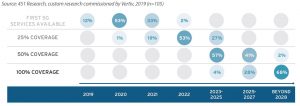
Survey participants were extremely optimistic about the outlook for the 5G business, and are aggressively moving forward with their implementation plans. In fact, 12% of operators plan to implement 5G services in 2019 and a further 86% plan to provide 5G services by 2021.
According to the survey, the business will initially focus on supporting existing data services (96%) and new consumer services (36%). About a third of those interviewed (32%) plan to support already known business services, while 18% say they are focusing on new solutions for businesses.
As networks continue to evolve and coverage expands, 5G itself will become a key enabler for emerging use cases requiring high-bandwidth, low-latency data transmission, such as virtual and augmented reality, digital healthcare, and smart homes, buildings, factories and cities.
However, considering the scale of the challenge, the majority of respondents (68%) do not expect to achieve full 5G coverage until at least 2028. 28% expect full coverage by 2027, while only 4% expect full coverage by 2025.
“Telecommunications companies recognize the opportunities presented by 5G, but also consider the network transformation required to support related services,” said Martin Olsen, vice president of global edge and integrated solutions at Vertiv. “This report sheds light on the challenges ahead and highlights the role of innovative, energy-efficient network infrastructure that will enable 5G to realize its potential.”
To support 5G services, telcos are increasing the deployment of multi-access edge computing (MEC) sites, which bring cloud capabilities directly to network access points. 37% of respondents said they had already implemented MEC infrastructure before the launch of 5G, while a further 47% intend to implement MEC architectures in a short time.
Due to Edge Computing, the ability to remotely monitor and manage more complex networks is becoming increasingly important in order to maintain high profitability. Data center infrastructure management (DCIM) was identified as the most important enabler (55%), followed by energy management (49%). Remote management of infrastructure will be key, as the report suggests that the network densification required by 5G could force operators to double the number of access stations around the world over the next 10 to 15 years.
The survey also asked respondents to identify their plans to address energy issues today and for the next five years, when large portions of the network support 5G, as 94% of participants expect network energy consumption to increase. Among the main data that emerged, the following stand out:
• The reduction of AC to DC conversion will continue, with 79% of respondents saying this is a focus today and 85% saying it will continue to be a focus for the next five years.
• New cooling techniques will see great development in the next five years. Currently used by 43% of telecommunications companies worldwide, these technologies will be adopted by 73% of enterprises within five years.
• The shift from VRLA to lithium-ion batteries also shows significant growth. Currently, 66% of telephone companies are upgrading their battery technology. In five years, the number is expected to rise to 81%.
“5G represents the most impactful and complex network evolution ever faced by the telecommunications industry,” said Brian Partridge, vice president of research at 451 Research. “Generally, companies recognize the scale of this challenge and the need to enable technologies and services to maintain profitability, more efficiently manage increasingly distributed networks and mitigate the impact of higher energy costs.”
Vertiv released the report in conjunction with its participation in Dell Technologies World, a global event focused on digital transformation. During the conference, Vertiv also presented a virtual reality (VR) solution that allows users to create a data center for 3D models and interact with designs through a VR system.