70% of women surveyed say they have experienced negative effects from remote working, compared to 30% of men*. Focusing on technologies that improve employee and IT experiences is critical to the success of the “future of work” and retaining talent
Ivanti, provider of the Neurons automation platform that discovers, manages, protects and supports IT assets from the cloud to the edge, presents the results of the annual Everywhere Workplace survey involving global experts on the topic of “The Future of Work”, interviewing over 6,100 employees and IT professionals to reveal employee assessments of the past, present and future of work. The report revealed how employee priorities are continuing to change with 71% of respondents saying they would prefer to work from anywhere rather than receive a promotion. Despite the growing diffusion of remote working, 10% of those interviewed found a negative effect on their health.
70% of women working in IT reported having experienced negative psychological effects related to remote working, compared to 30% of men belonging to the same sector*. In addition, many employees feel the loss of interpersonal contact with their colleagues (9%), adding that they work longer hours than when they were in the office (6%). The report also showed a further gender gap: 56% of women surveyed said remote working had negatively affected their mental health, compared to 44% of men. While 52% of women report having lost interpersonal contact with colleagues, compared to 47% of men.
"Ivanti's research shows how remote working for both office workers and IT professionals varies by gender. Within this digital-first culture, many men say they have been passed over for a promotion. Women, however, despite expecting to work longer, have benefited more from the flexibility that characterizes this new way of working. This change in the employee experience cannot be ignored. Employers must respond by adopting technology that facilitates collaboration and reduces experience disparities between genera. All this is possible by considering the contribution of employees in every technological implementation,” he said Meghan M. Biro, founder and CEO of Talent Culture.
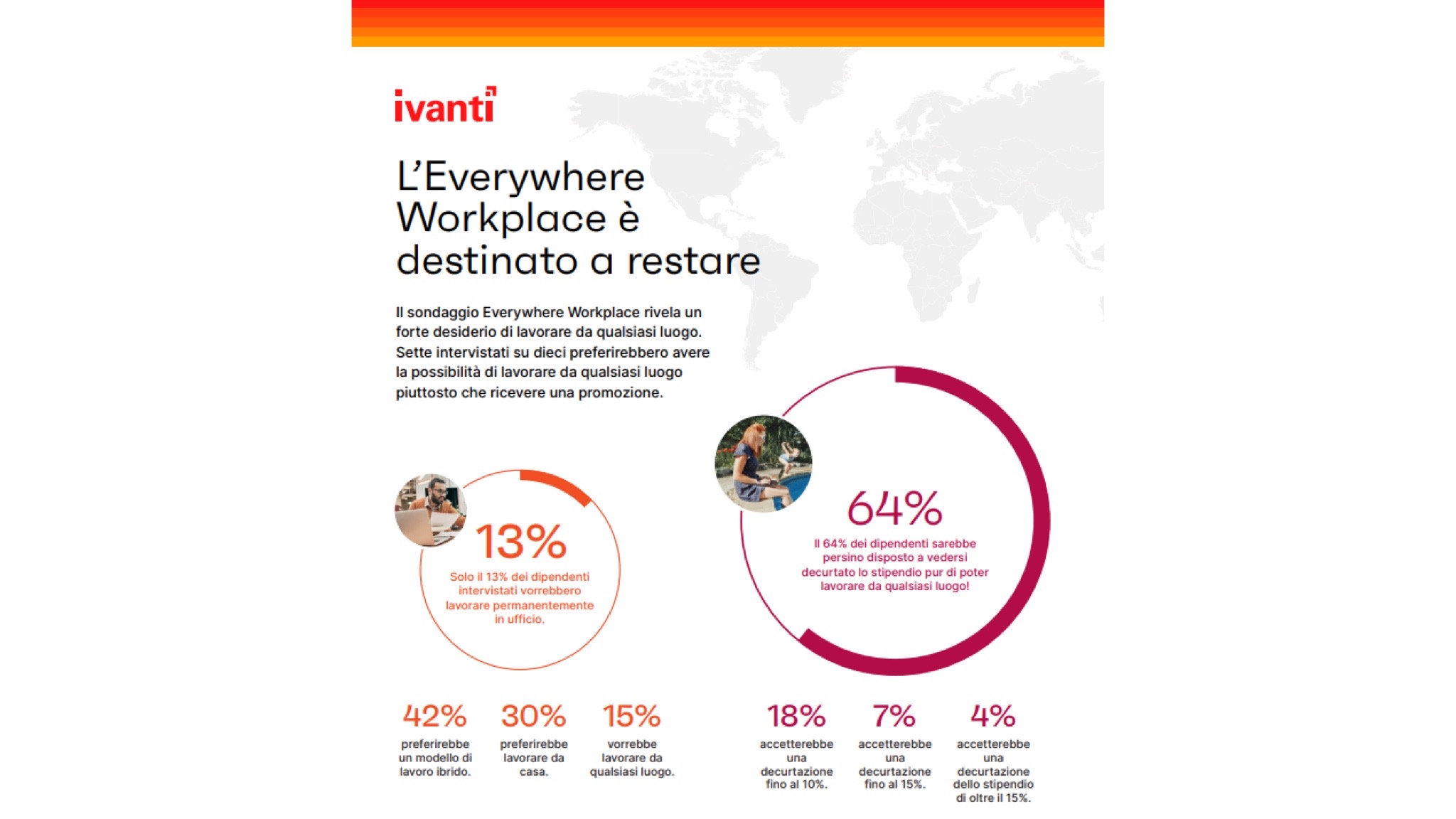
Looking at potential future working models, the research highlights that 42% of employees prefer hybrid working methods (+5% since the last study). 30% of them instead opt to work from home permanently (-20% since the last study), demonstrating a willingness to interact with their colleagues again. Despite the various benefits of remote working, including time savings on travel (48%), better work-life balance (43%) and more flexible working hours (43%), there have been some disadvantages. In fact, 49% of respondents say they have been negatively affected by remote working due to poor interaction with colleagues (51%), lack of collaboration and communication (28%), risk of background noise and some distractions (27%).
“The pandemic has introduced a huge change in the ways and places of work,” he said Jeff Abbott, CEO of Ivanti. "The advantage is certainly in the progressive implementation of automation for daily activities and tasks. In this way companies can optimize the work-life balance of their IT and security teams, preventing data breaches and improving employee experiences. The Ivanti Neurons platform for example allows IT departments to reduce complexity, anticipate possible threats, reduce unplanned interruptions and resolve endpoint problems before they are reported by employees."
In the face of increasingly complex work environments, automation will take on a central role. In fact, 15% of those interviewed would prefer to work from anywhere (+87% since the last survey). It is interesting to note that 22% of those interviewed have become a "digital nomad", 18% are considering becoming one versus 13% who would like to work permanently in the office (-11% since the last survey).
The research also found that just under a quarter (24%) of respondents have left their job in the last year while 28% are considering a change in the next six months. Analyzing respondents aged 25 to 34, the percentage of individuals planning to leave their job in the next six months increased to 36%. Return-to-office policies are crucial in the decision to resign. Nearly a quarter (24%) of respondents said they would leave their company if their employer required them to return to work full-time in the office.
“Employees have multiple options: they can go anywhere and work for anyone,” Biro said. “This means that to retain their talent, companies must implement technologies capable of simplifying and making everyone's work enjoyable.”
“To be able to retain talent it is essential to develop a winning, diverse and inclusive culture where every individual is respected, and the mission and values of a company are present at all levels,” added Abbott. "Today, people want to work for companies that make a difference. Companies must demonstrate that they are capable of producing global value and not just profits, while also prioritizing the right balance between private life and work."
Looking ahead, 26% of respondents hope IT will deliver new hardware such as laptops, desktops and mobile devices in 2022, and 26% call for service desk modernization. Among IT teams, the latter aspect reaches 32%. Considering the increased volumes of service desk requests during the pandemic, high operational costs and reduced employee productivity, this should not be surprising.
To learn more about the findings from Ivanti's latest Everywhere Workplace Report, see the following link.